A Patient Guide to Fixed Teeth and Advanced Dental Implant Rehabilitation
Could You Have Fixed Teeth Without Months of Conventional Implant Treatment?
Losing teeth is not simply a dental problem.
It can affect how you eat, speak, smile, socialize and feel about yourself.
For patients with multiple missing teeth, severe bone loss, failing teeth or previous unsuccessful dental treatments, conventional implant treatment may sometimes involve several stages, healing periods and additional procedures.
But there is another implantology concept that deserves to be understood:
Corticobasal implantology with immediate functional loading.
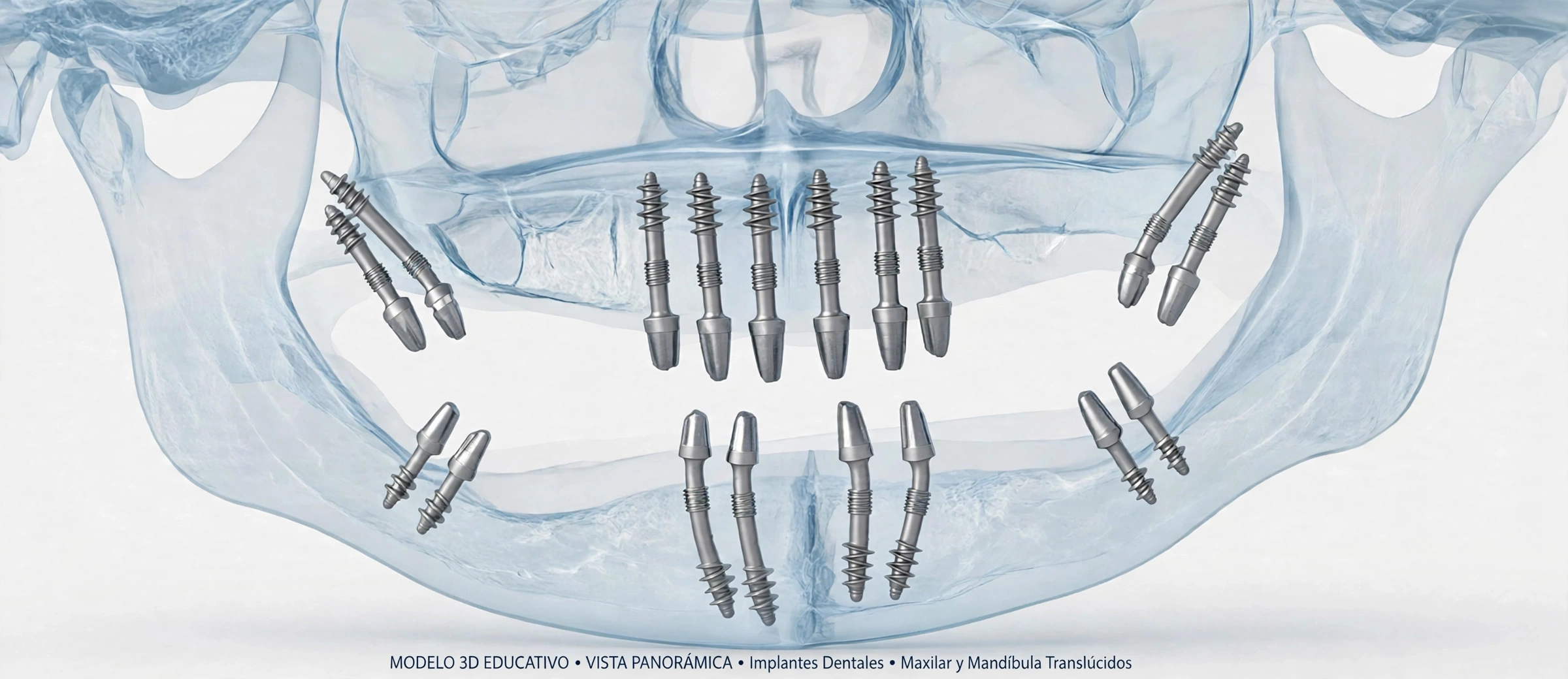
This approach uses implants designed to obtain mechanical anchorage in strategically selected areas of dense cortical bone. In appropriately selected cases, this can allow a fixed provisional prosthesis to be connected shortly after implant placement.
That does not mean that every patient can receive definitive teeth on the same day.
It means that, when the clinical conditions are favorable, an immediate-loading protocol may allow the patient to transition to a fixed restoration much sooner than with some conventional treatment protocols.
This distinction is extremely important when evaluating treatment options.
What Is Corticobasal Implantology?
Corticobasal implantology is an implant treatment concept based on anchorage in cortical bone rather than relying exclusively on the traditional crestal bone healing concept used in many conventional implant protocols.
Corticobasal implants are designed to engage areas of dense cortical bone that can provide mechanical stability.
The International Implant Foundation’s 2024 consensus document describes corticobasal implants as a distinct treatment modality based on cortical anchorage and immediate functional loading.
This is fundamentally different from simply saying:
“It is a faster conventional dental implant.”
It is better understood as a different biomechanical approach to implant rehabilitation.
The central concept
Conventional implant dentistry commonly emphasizes biological osseointegration around the implant surface.
Corticobasal implantology places particular emphasis on:
- Cortical bone anchorage
- Primary mechanical stability
- Strategic implant positioning
- Prosthetically driven treatment planning
- Rigid splinting when indicated
- Immediate functional loading in appropriately selected cases
The 2019 consensus literature describes corticobasal implants as implants intended to obtain fixation in cortical bone areas and to be used in immediate-loading protocols.
What Does “Immediate Loading” Actually Mean?
This is one of the most important questions patients should ask.
Immediate loading does not necessarily mean that your final, definitive teeth are manufactured and delivered on the day of surgery.
In implant dentistry, immediate loading generally means that a prosthesis is connected to the implants shortly after implant placement and placed into functional use, when clinical conditions permit.
A recent 2026 global consensus on edentulous maxillary rehabilitation defines immediate loading as connecting implants to a prosthesis in occlusion with the opposing arch within one week of implant placement.
In selected situations, this may occur on the same day.
The treatment may therefore involve:
Implant placement → fixed provisional restoration → healing and tissue maturation → definitive prosthesis.
This is very different from promising every patient “permanent teeth in one day.”
The Cortical Bone: Why Does It Matter?
The jaw contains different types and densities of bone.
For corticobasal implantology, the cortical regions can play an important role because they are generally denser and more resistant to resorption than much of the alveolar cancellous bone.
The treatment philosophy therefore focuses on identifying appropriate anatomical areas capable of providing mechanical anchorage.
Think of it this way:
Conventional concept
The implant is placed into the available alveolar bone and is expected to become biologically integrated during healing.
Corticobasal concept
The implant is strategically positioned to engage suitable cortical structures and obtain mechanical fixation that can support an immediate-loading protocol when the case allows it.
The actual anatomy is considerably more complex than this simplified explanation, which is why CBCT-based planning and advanced implant experience are essential.
Can Corticobasal Implants Help Patients With Severe Bone Loss?
This is one of the most frequently searched questions.
Patients are often told:
“You don’t have enough bone for implants.”
But “not enough bone” is not necessarily the end of the conversation.
It is important to determine:
- Where the remaining bone is located
- Which cortical structures are available
- The quality and quantity of bone
- The condition of the soft tissues
- The position of anatomical structures
- Occlusal forces
- Existing teeth and restorations
- Periodontal condition
- General medical factors
- Prosthetic requirements
A 2025 review specifically evaluated basal implants as a treatment alternative for severely resorbed ridges. It identified 21 articles involving 9,732 basal implants in 1,219 patients and reported survival/success rates ranging across studies from 90.3% to 100% for intraoral basal implants. The authors concluded that basal implant-supported prostheses may represent a practical treatment modality, while also emphasizing the limitations inherent in the available evidence.
This is encouraging evidence, but it should not be interpreted as a guarantee for an individual patient.
Does Corticobasal Implantology Eliminate Bone Grafting?
Not automatically.
This is an important distinction for patients researching:
“dental implants without bone grafting.”
In certain cases, corticobasal treatment may allow implant anchorage in areas that make traditional augmentation unnecessary.
However, whether bone grafting is necessary depends on the patient’s anatomy and treatment objectives.
A responsible implant consultation should therefore answer:
Can this particular patient be treated without bone grafting?
—not:
Can corticobasal implants eliminate bone grafting for everyone?
Clinical reports have described successful immediate-loaded corticobasal rehabilitation in complex patients without grafting procedures, but these reports represent specific clinical situations and should not be generalized to every patient.
Who May Be a Candidate for Corticobasal Implants?
Potential candidates may include patients with:
- Multiple missing teeth
- Completely edentulous jaws
- Advanced tooth loss
- Severe alveolar ridge resorption
- Failing teeth requiring comprehensive rehabilitation
- Previous conventional implant challenges
- Significant posterior bone loss
- A desire for a fixed restoration
- A need for accelerated rehabilitation
- Certain cases where conventional augmentation would be complex
But candidacy cannot be established from a photograph or panoramic X-ray alone.
A comprehensive examination is required.
Who May NOT Be a Candidate?
Corticobasal implantology is not a universal solution.
Additional caution may be required in patients with:
- Uncontrolled systemic disease
- Active untreated infection
- Severe uncontrolled periodontal disease
- Poor oral hygiene
- Inadequate ability to maintain the prosthesis
- Uncontrolled bruxism
- Heavy smoking
- Certain medications or medical conditions affecting bone healing
- Anatomical limitations
- Unrealistic expectations
- Inadequate prosthetic space
- Severe occlusal problems
The final decision should be made after clinical examination, imaging and treatment planning.
What Does the Treatment Process Look Like?
Step 1 — Comprehensive Diagnosis
The process begins with an evaluation of the entire oral system.
This may include:
- Clinical examination
- Periodontal evaluation
- Occlusal analysis
- Dental photography
- Panoramic imaging
- CBCT/3D imaging
- Digital scanning
- Prosthetic analysis
- Medical history
- Assessment of existing restorations
For international patients, previous dental records and recent CBCT images may also be reviewed before traveling.
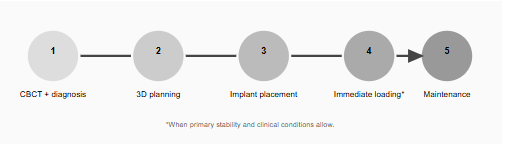
Step 2 — 3D Treatment Planning
The objective is not simply to ask:
“Where can we put an implant?”
The better question is:
“Where should the implants be positioned to create a stable, functional and maintainable prosthetic rehabilitation?”
Modern implant planning increasingly emphasizes a prosthetically driven approach.
The 2026 global consensus on edentulous maxillary rehabilitation reported strong expert support for prosthetically guided treatment planning and highlighted guided surgery as a preferred approach among surveyed specialists.
Step 3 — Implant Placement
The implants are strategically positioned according to the patient’s anatomy and the planned prosthetic design.
Depending on the case, treatment may involve:
- Individual teeth
- Multiple adjacent teeth
- Segments
- Full-arch rehabilitation
- Upper jaw rehabilitation
- Lower jaw rehabilitation
- Complex cases involving severe bone resorption
The exact number and position of implants are individualized.
There is no single number that works for every patient.
Step 4 — Immediate Functional Loading
If adequate primary stability and favorable clinical conditions are achieved, an immediate-loading protocol may be considered.
A fixed provisional prosthesis can sometimes be connected soon after implant placement.
The purpose is to provide the patient with a fixed restoration while the biological and mechanical aspects of treatment continue to be monitored.
The 2026 global consensus specifically states that immediate loading should be considered when clinical conditions are favorable and adequate primary stability has been achieved.
Step 5 — Definitive Prosthetic Rehabilitation
The provisional restoration is not necessarily the final restoration.
After appropriate clinical evaluation and maturation, the definitive prosthesis can be planned.
Depending on the case, the final restoration may incorporate materials such as:
- High-strength acrylic systems
- Composite materials
- Hybrid prosthetic designs
- Ceramic
- Zirconia
- Other laboratory-designed restorative materials
The choice depends on:
- Occlusion
- Available space
- Aesthetics
- Functional demands
- Implant distribution
- Lip support
- Facial proportions
- Hygiene requirements
- Patient expectations
- Prosthetic design
Can You Get Fixed Teeth in One Day?
Sometimes.
But the correct clinical wording is:
Selected patients may receive a fixed provisional restoration immediately or shortly after implant placement.
That is very different from promising every patient a definitive permanent prosthesis on the same day.
This distinction is particularly important for international patients traveling specifically for:
“same-day dental implants.”
The treatment timeline should be explained before the patient purchases a flight.
What Are the Advantages of Immediate-Loading Corticobasal Implantology?
When appropriately indicated, the treatment concept may offer several potential advantages.
1. Reduced treatment time
Some patients can transition to a fixed restoration much faster than with conventional staged protocols.
2. Fixed teeth during the rehabilitation process
For selected cases, immediate loading can avoid an extended period using a removable temporary prosthesis.
3. Treatment options for severely resorbed ridges
The use of strategic cortical anchorage may expand treatment possibilities in certain patients with advanced bone resorption.
4. Potential reduction in augmentation procedures
In selected anatomical situations, the treatment may avoid some conventional bone augmentation procedures.
5. Functional rehabilitation
A properly designed fixed prosthesis can restore:
- Mastication
- Speech
- Smile aesthetics
- Facial support
- Oral function
6. Psychological benefits
Losing teeth can affect social confidence and self-image.
Restoring a fixed smile can have significant quality-of-life implications.
A 2025 review found that published basal implant studies generally reported positive patient satisfaction and quality-of-life outcomes, although the authors also noted variability in the evidence.
What Does the Scientific Evidence Say?
This question deserves an honest answer.
The scientific literature on basal and corticobasal implantology is growing, but it is not as extensive as the literature surrounding conventional endosseous implant systems.
A 2025 review evaluated available studies involving basal implants and found a substantial body of published clinical data, including thousands of implants and more than a thousand patients. However, the evidence base includes observational studies, clinical series and other designs with different methodological limitations.
A prospective observational study published in 2023 evaluated 174 corticobasal implants in 20 patients with compromised ridge support. At 18 months, the study reported 100% implant survival, with high patient satisfaction and manageable prosthetic complications.
These results are relevant.
But one study involving 20 patients cannot establish that the treatment is appropriate for everyone.
That is why diagnosis, surgeon experience, case selection and long-term maintenance remain critical.
Corticobasal vs Conventional Dental Implants
Patients often ask:
“Which implant system is better?”
There is no responsible universal answer.
The two approaches involve different biological and biomechanical philosophies.
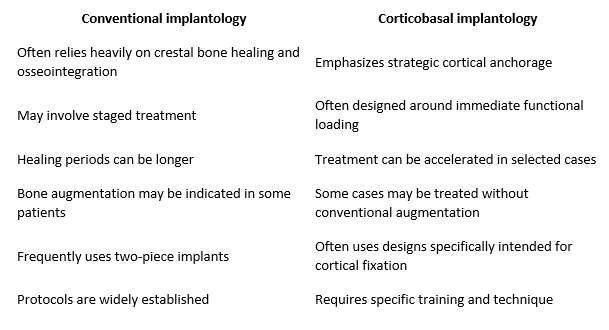
The correct treatment is the one that is biologically, mechanically and prosthetically appropriate for the individual patient.
Is Corticobasal Implantology the Same as All-on-4 or All-on-6?
No.
These concepts should not be confused.
All-on-4 and All-on-6 generally describe full-arch prosthetic concepts based on a specified number of implants.
Corticobasal implantology describes a different implantological and biomechanical treatment philosophy based on strategic cortical anchorage and immediate functional loading.
A corticobasal rehabilitation can involve individual teeth, segments or full arches.
Therefore:
and
They are different concepts that should be evaluated according to anatomy, biomechanics and prosthetic objectives.
Can Corticobasal Implants Be Used for Individual Teeth?
Depending on the anatomy and clinical indication.
Corticobasal implantology is not necessarily limited to full-mouth rehabilitation.
Treatment planning can involve:
- A single missing tooth
- Multiple individual teeth
- Several adjacent teeth
- Posterior segments
- Anterior segments
- Complete arches
The appropriate approach depends on the specific clinical situation.
What About Full-Arch Rehabilitation?
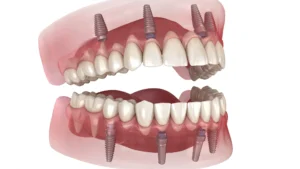
For patients who have lost most or all teeth, full-arch rehabilitation may be considered.
The treatment objective is not simply to replace missing teeth.
It is to create an integrated system involving:
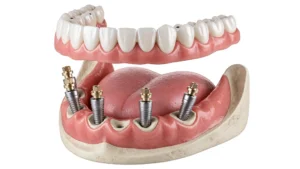
Implants + prosthesis + occlusion + soft tissues + hygiene + maintenance.
A successful full-arch rehabilitation must function as a complete biomechanical system.
What Happens If You Have “No Bone”?
This is one of the most important questions for patients considering advanced implant treatment.
The phrase:
“You don’t have enough bone.”
can be misleading if it is based only on a limited radiographic evaluation.
A better diagnostic question is:
“Where is the available bone, and can it provide predictable implant anchorage?”
CBCT imaging can reveal anatomical structures that cannot be adequately evaluated from a conventional 2D radiograph.
The treatment plan can then be developed around the patient’s actual anatomy.
However, severe bone loss can still represent a major clinical challenge.
Not every severely resorbed jaw is treatable with corticobasal implants.
Does the Procedure Hurt?
Pain is one of the most common concerns.
Implant surgery is performed using appropriate local anesthesia, and sedation may be considered depending on the patient and clinical circumstances.
Postoperative discomfort varies according to:
- Number of implants
- Surgical complexity
- Extraction requirements
- Individual pain sensitivity
- Soft-tissue manipulation
- Medical factors
Patients should receive individualized postoperative instructions and medication protocols from their treating clinician.
What Are the Possible Risks?
No implant treatment is risk-free.
Potential complications may include:
- Implant mobility or failure
- Infection
- Peri-implant inflammation
- Soft-tissue complications
- Prosthetic fracture
- Prosthetic wear
- Screw or component complications, depending on the system
- Occlusal problems
- Speech adaptation
- Difficulty cleaning
- Aesthetic dissatisfaction
- Implant loss
- Need for prosthetic repair or replacement
Complex full-arch cases require particularly careful maintenance.
The objective should never be simply to place implants quickly.
The objective is to create a stable, functional and maintainable rehabilitation.
Why Maintenance Matters
Receiving fixed teeth is not the end of treatment.
It is the beginning of a long-term maintenance program.
Patients should receive professional monitoring of:
- Implant stability
- Soft-tissue health
- Plaque control
- Prosthetic components
- Occlusion
- Prosthetic wear
- Hygiene access
- Bone levels
- Patient comfort
The 2026 global consensus emphasizes supportive maintenance care and regular follow-up as important components of implant rehabilitation.
What About Smoking?
Smoking deserves special attention.
Tobacco exposure can negatively affect oral tissues and implant treatment outcomes.
A patient who smokes should discuss this honestly with the implantologist before treatment.
Smoking does not automatically mean that every implant procedure is impossible, but it is an important risk factor that should be incorporated into treatment planning and maintenance.
What About Bruxism?
Bruxism can place substantial mechanical stress on implant-supported prostheses.
For patients who grind or clench their teeth, treatment planning may need to consider:
- Occlusal design
- Prosthetic material
- Implant distribution
- Prosthetic framework
- Night guards where appropriate
- Long-term monitoring
Ignoring parafunctional forces can compromise an otherwise technically successful rehabilitation.
Dental Tourism: Can International Patients Travel for Corticobasal Implant Treatment?
Yes, but international patients should plan carefully.
If you are traveling from the United States, Canada, the United Kingdom, Europe or another country for dental implant treatment in Colombia, your decision should not be based exclusively on price.
Before traveling, ask:
1. Who will perform the treatment?
Verify professional credentials, implant training and experience with the specific technique.
2. What implant system will be used?
Ask for:
- Manufacturer
- Implant model
- Materials
- Prosthetic components
- Documentation
3. What imaging is required?
Ask whether a CBCT is necessary before finalizing treatment.
4. What happens after surgery?
You need a clearly defined follow-up protocol.
5. What happens when you return home?
Ask what happens if:
- A prosthetic component needs adjustment
- You experience discomfort
- Your bite changes
- The prosthesis requires repair
6. What exactly is included in the price?
Request a written treatment plan covering:
- Diagnostic evaluation
- Surgery
- Implants
- Provisional prosthesis
- Definitive prosthesis
- Laboratory work
- Medications
- Follow-up
- Potential additional procedures
This is particularly important when comparing dental implant treatment abroad.
Why Bogotá, Colombia Is Becoming an Important Destination for Dental Tourism
Colombia has become increasingly visible internationally as a destination for medical and dental services.
For an international patient, the value proposition should not be:
“Cheap dental implants.”
A premium dental tourism strategy should instead focus on:
Advanced diagnosis + specialist care + technology + treatment planning + personalized rehabilitation + transparent communication.
Patients traveling internationally are often looking for expertise rather than simply the lowest price.
This is particularly relevant for complex implant cases.
How Much Do Corticobasal Dental Implants Cost?
There is no universal price.
The cost depends on:
- Number of implants
- Jaw involved
- Individual vs segmental vs full-arch rehabilitation
- Extractions
- Provisional prosthesis
- Definitive prosthesis
- Prosthetic material
- Laboratory requirements
- Diagnostic imaging
- Sedation
- Complexity of the case
- Previous failed treatment
- Additional procedures
For international patients, it is useful to request a complete treatment estimate, rather than simply asking:
“How much is one implant?”
A complex full-arch rehabilitation should be evaluated as a complete treatment system.
Questions to Ask Before Choosing a Corticobasal Implantologist
Before committing to treatment, ask these questions:
“What type of implant will you use?”
“Where will the implants be anchored?”
“Why is this technique appropriate for my anatomy?”
“Will I receive a provisional fixed prosthesis?”
“When will my definitive prosthesis be delivered?”
“Do I need bone grafting?”
“What happens if an implant fails?”
“What is the maintenance protocol?”
“What happens if I return to my home country?”
“What documentation will I receive?”
“Who will fabricate my prosthesis?”
These questions help patients make an informed decision.
The Most Important Question Is Not “How Fast?”
It is:
“Why Is This Treatment Appropriate for Me?”
Speed is attractive.
A fixed smile in a short period can be life-changing.
But speed should never replace diagnosis.
The strongest treatment plan is one in which the clinician can explain:
- Why the implants are being placed where they are
- Why immediate loading is appropriate
- How the prosthesis will be designed
- How occlusion will be controlled
- What risks exist
- How the patient will be monitored
- What happens if complications occur
Corticobasal Implantology: Who Should Consider an Evaluation?
If you have been told:
“You don’t have enough bone for implants.”
or:
“You need extensive bone grafting.”
or:
“You need to wait many months before getting fixed teeth.”
it may be reasonable to seek a specialized second opinion.
That does not mean corticobasal implants will necessarily be the correct solution.
It means your case deserves a complete evaluation of all available anatomical and prosthetic options.
Frequently Asked Questions
Can corticobasal implants be loaded immediately?
In appropriately selected cases, yes. Immediate functional loading is a defining component of the corticobasal treatment concept, but adequate primary stability and favorable clinical conditions are essential.
Can I get fixed teeth on the same day?
Some patients can receive a fixed provisional restoration immediately or shortly after surgery. The definitive restoration may be delivered later.
Can corticobasal implants be used with severe bone loss?
They may be considered in selected patients with severe ridge resorption, but the anatomy must be evaluated individually.
Do corticobasal implants require bone grafting?
Not necessarily. Some cases can be treated without conventional bone augmentation, but there is no universal “no graft” rule.
Are corticobasal implants permanent?
Implant-supported restorations are intended as long-term treatment, but no responsible clinician should guarantee that an implant or prosthesis will last forever.
Long-term success depends on biology, biomechanics, oral hygiene, maintenance, occlusion, systemic factors and patient behavior.
Can smokers receive corticobasal implants?
Smoking should be considered a significant risk factor. The clinician must evaluate the individual situation.
Can corticobasal implants replace all my teeth?
In appropriately selected cases, corticobasal implant-supported rehabilitation can be used for extensive or full-arch tooth replacement.
Are corticobasal implants the same as All-on-4?
No. They are different treatment concepts.
Are corticobasal implants the same as All-on-6?
No. All-on-6 describes a six-implant full-arch concept, while corticobasal implantology describes a specific implantological and biomechanical approach.
Can international patients receive treatment in Colombia?
International patients can seek treatment in Colombia, but they should verify the clinician’s credentials, treatment plan, implant system, prosthetic materials, follow-up arrangements and total cost before traveling.
The Future of Advanced Implant Rehabilitation
Modern implantology is moving toward increasingly individualized treatment planning.
The future is not simply:
“More implants.”
It is:
Better diagnosis.
Better planning.
Better biomechanics.
Better prosthetic design.
Better maintenance.
Digital CBCT imaging, digital scanning, computer-assisted planning and prosthetically driven implant positioning are increasingly important components of comprehensive implant rehabilitation.
The 2026 global consensus on rehabilitation of the edentulous maxilla specifically emphasizes patient-centered treatment planning, diagnostic evaluation, prosthetically guided approaches and appropriate loading protocols.
Are You a Candidate for Corticobasal Immediate-Loading Implantology?
If you have missing teeth, failing teeth, severe bone loss or have previously been told that conventional implants are not possible, a specialized evaluation may provide additional information.
Your treatment should begin with your anatomy—not with a generic treatment package.
At Dr. Armando Lagos, the evaluation can be approached around three fundamental questions:
1. What is the current condition of your teeth and bone?
2. Which implant strategy is appropriate for your anatomy?
3. Can your rehabilitation be planned around a fixed and functional prosthetic solution?
If you are an international patient, your initial evaluation can also be structured around your travel requirements, diagnostic information and expected treatment timeline.
Ready to Explore Your Options?
You do not need to make a decision based on a social media advertisement.
Start with a professional evaluation.
If you have been told that you have insufficient bone, need extensive grafting, or must wait months before receiving fixed teeth, ask whether a corticobasal immediate-loading implant evaluation could be appropriate for your specific anatomy.
REQUEST YOUR CORTICOBASAL IMPLANT EVALUATION
International patients:
Send your recent dental records, panoramic X-ray or CBCT when available, photographs and a brief description of your dental concerns.
Our team can review the information and determine whether an in-person evaluation in Bogotá may be appropriate.
Your treatment should be designed around your anatomy, your function and your long-term oral health—not around a one-size-fits-all protocol.